Your Cart
Total:
$0.00



 July 7 2025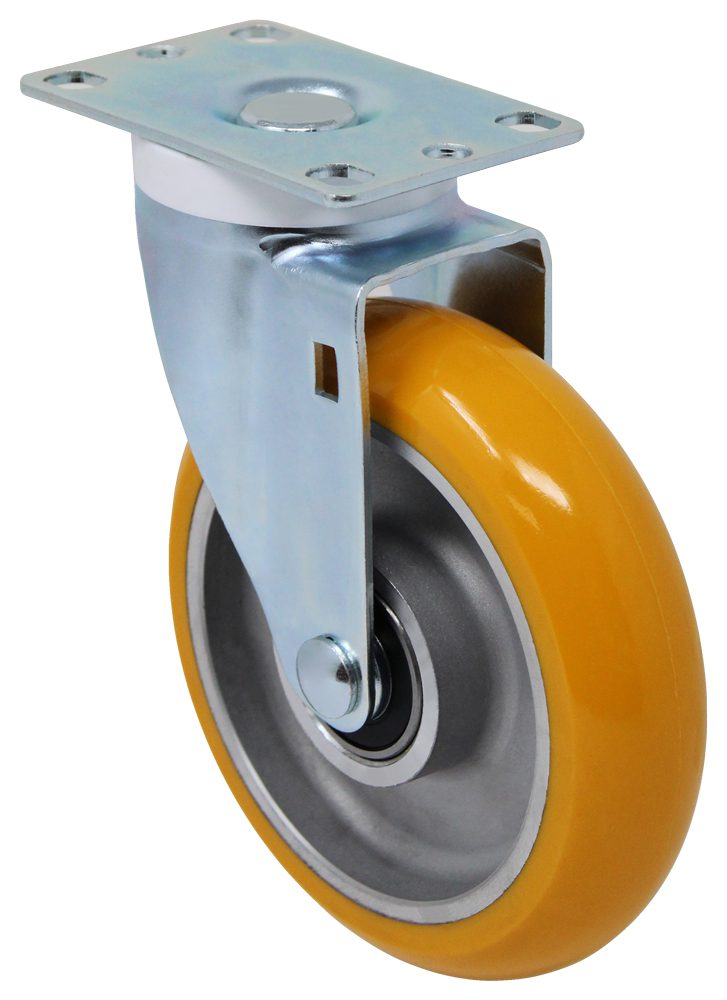
Stainless steel casters, offered in both plate and stem mounting styles, are built for use in wet, corrosive, or high-temperature environments where durability and cleanliness are critical. These casters are available in both 304 and 316 stainless steel ‑ the former offering strong corrosion resistance for general industrial and food service use, and the latter providing superior protection against harsh chemicals and saltwater, making it ideal for marine and pharmaceutical applications. Designed to handle temperatures up to 450°F when paired with high-temp wheels and raceway seals, these casters perform reliably in extreme heat such as in autoclaves or commercial ovens.
Caster City’s stainless steel casters are built with longevity and performance in mind. Each unit includes a grease fitting in the swivel bearing for easy maintenance, protective seals, and a dust cover to guard internal components from contaminants. Whether you choose 304 for its broad utility or 316 for its maximum corrosion resistance, these casters ensure smooth, low-maintenance mobility in the most demanding conditions.
Getting to know the difference between grades helps you pick the right one for the job, instead of over-paying for corrosion resistance you don’t need, or under-buying for an environment that will eat through standard hardware in a season.
304 stainless steel is the most common grade used across food service, medical equipment, and general industrial hardware. Its chromium and nickel content makes it strong against rust and staining, and it doesn’t react with food, which is why it shows up constantly in kitchens and sanitary environments. As a raw material, 304 tolerates very high heat, but on an assembled caster, the wheel and bearing grease set the real limit, typically up to 450°F when paired with a high-temperature wheel. Cleaning is easy, which matters in any environment that needs to stay sanitized.
316 stainless steel builds on 304 with a higher nickel content and 2–3% molybdenum, which specifically improves resistance to pitting and crevice corrosion ‑ the failure mode caused by salt and chlorides. That makes 316 the standard choice for marine equipment and chemical processing, and anywhere else exposed to high salt or chloride levels. It costs more than 304, but in genuinely harsh conditions that extra cost typically pays for itself by avoiding early rust failure.
304 holds up well in general-purpose settings but isn’t built for sustained exposure to chlorides. 316’s added molybdenum specifically fights pitting and crevice corrosion, making it the better choice for marine environments or chemical processing plants.
316 generally outperforms 304 in tough environments such as marine air, washdown chemicals, and high-chloride settings, showing less wear over time where 304 would start to show damage. For projects needing long-term performance in a corrosive setting, 316 is typically the safer bet.
316 costs more than 304 because of its added nickel and molybdenum. In marine, chemical, or food-processing washdown environments, that premium often pays for itself by preventing early rust failure. If the environment isn’t corrosive, 304 is usually the more cost-effective choice without added risk.