Your Cart
Total:
$0.00




 August 24 2026
 A cart that drifts to one side, refuses to turn in a tight aisle, or takes two people to steer around a corner usually isn’t broken. It’s running the wrong type of caster. Swivel and rigid casters look similar at a glance, but the way each one moves changes everything about how a piece of equipment handles once it’s loaded and rolling.
Getting this choice right matters more on heavy equipment than light. A stem caster on an office chair is forgiving. A plate caster under a 2,000-pound cart is not, and the wrong combination can mean equipment that fights the operator on every turn or wanders off a straight path under load.
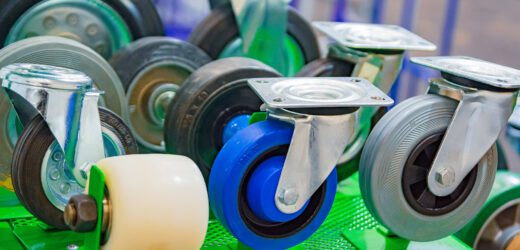
A swivel caster is built with a raceway and ball bearing assembly mounted above the wheel fork, which lets the entire wheel assembly rotate a full 360 degrees around a vertical axis. The wheel itself still spins on its horizontal axle the way any caster wheel does, but that added swivel section is what allows the caster to pivot and follow whichever direction the equipment is pushed or pulled. This is the caster type most people picture when they think of a rolling cart, since it’s what lets a load change direction without being lifted or forced.
Swivel casters are the right call whenever equipment needs to change direction without being picked up or forced. Because each wheel can pivot independently, a piece of equipment on all-swivel casters can turn in place, thread through tight aisles, and reposition around corners with relatively little effort. This makes them a natural fit for shopping carts, hospital equipment, warehouse carts, and anything else that moves through variable, unpredictable paths rather than a single fixed route.

A rigid caster, sometimes called a fixed caster, has its fork bolted directly to the mounting plate or stem with no rotating section in between. The wheel only turns on its horizontal axle, so it can roll forward and backward but has no way to change direction on its own. Any turning has to come from the equipment itself, or from other casters in the setup. Rigid casters trade maneuverability for a straighter, steadier roll, which is why they show up on equipment that mostly travels a fixed path rather than weaving through space.
Rigid casters give up that maneuverability in exchange for stability. Because the wheel can’t pivot, there’s nothing for it to wander on, which means less drag and a straighter, steadier roll over long, mostly linear distances. This is a real advantage on heavier loads, where a swivel wheel that isn’t tracking straight can add resistance and make equipment feel harder to push than it should. Rigid casters are common on tool chests, dollies, hand trucks, and industrial equipment that mostly travels in a straight line from one point to another, such as moving machinery down a warehouse aisle.
The difference comes down to how the wheel fork is mounted.
A rigid caster has its fork bolted directly to the mounting plate or stem, with no rotating section between them. The wheel only turns on its horizontal axle, so the caster can roll forward and backward but has no way to change direction on its own. Any turning has to come from the equipment itself, or from other casters in the setup.
A swivel caster adds a raceway and ball bearing assembly above the fork, which lets the entire wheel assembly rotate a full 360 degrees around a vertical axis. The wheel still spins on its horizontal axle the same way a rigid caster’s does, but that added swivel section is what lets the caster pivot and follow the direction the equipment is pushed.
A few questions make the choice easier:
For most carts and mobile equipment, the answer isn’t swivel or rigid. It’s a mix of both, sized and matched to the load.
Whichever type is used, a few factors decide how well a caster actually performs under load:
These specs apply whether the caster is swivel or rigid, and getting them wrong is usually a bigger problem than picking the wrong pivot type.
Very few carts run on all-swivel or all-rigid setups. The most common configuration pairs two swivel casters at the front for steering with two rigid casters at the back for straight-line stability, similar to how a shopping cart handles. This gives the operator control over direction while keeping the load from drifting sideways once it’s moving. Adding total locking brake casters to one or more corners is also common on carts that need to stay put once positioned, since a total lock secures both the wheel and the swivel at the same time.
The type of caster underneath a cart or piece of equipment has more influence over how it handles than most people expect. Swivel casters bring the maneuverability, rigid casters bring the stability, and most well-built equipment relies on both working together rather than picking one over the other. Matching the wheel material, size, and capacity to the actual load matters just as much as getting the swivel-versus-rigid decision right, so it’s worth checking both before finalizing an order.