Your Cart
Total:
$0.00



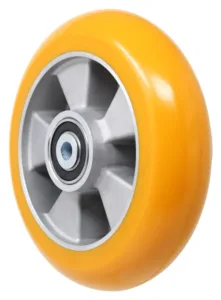
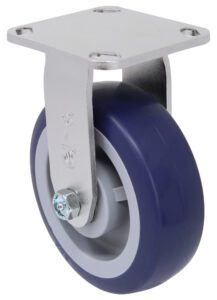
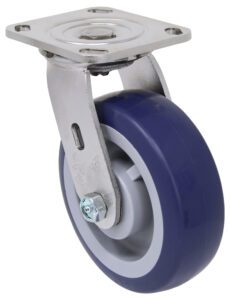
Polyurethane casters offer a versatile solution tailored to a wide range of industrial applications, balancing load capacity with floor protection and maneuverability. Within the polyurethane, two distinct manufacturing processes ‑ liquid cast and injection molded ‑ yield casters with unique characteristics, we will be discussing them both briefly as well.
These solid all polyurethane caster wheels are non marking. The absence of a metal center eliminates bond failure as a cause for wheel replacement. These caster wheels are especially suited for use with stainless steel casters in wet and corrosive applications.
The Blue “AP” All Polyurethane wheel is a standard duty wheel good for up to 1000lbs in the 8×2.
The Gray “HU” High Capacity Solid Polyurethane Wheel is a solid wheel designed for heavier sanitation and food grade needs. Up t0 3000lbs per wheel in the 10×3.
They are designed for use in Pharmaceutical Laboratories, Hospitals, and Food Processing Plants – wherever a clean sanitary design is desired. These wheels are not recommended for applications involving shock, overloading, abuse, obstructions, poor floors, or for storage (standing) loads. Hardness is 60 – 65 Durometer Shore D. Temperature range is -20° to 180° F. Standard wheel color is Blue.
These wheels are designed for use in a wet environment and they eliminate the possibility of tire separation.
R = Roller Bearing, D = Delrin Bearings, P = Plain Bore, BB = Ball Bearings, PS = Precision Sealed Ball Bearings, SPS = Stainless Precision Sealed Ball Bearings
Polyurethane casters excel in noise reduction, providing a quieter operation ideal for noise-sensitive environments. Their shock-absorbing properties significantly diminish sound output compared to harder materials.
Both types of polyurethane casters effectively handle substantial loads. However, liquid cast polyurethane is particularly suited for applications where equipment remains stationary for extended periods.
This type maintains its shape and integrity under static pressure, preventing deformation and flat spots, thus ensuring consistent performance without damaging floors.
Check our range of polyurethane wheels with iron centers here.
Polyurethane casters, known for their excellent grip, perform exceptionally well on both smooth and uneven surfaces, reducing slippage and enhancing safety. This feature is crucial in environments with wet or irregular floors.
With varying levels of resistance to environmental factors, selecting a polyurethane caster that matches your specific conditions is crucial for maximizing lifespan and maintaining functionality.
This type is renowned for its durability and resilience, especially under static loads. The flexibility and strength of liquid cast polyurethane make it an ideal choice for heavy-duty applications where the caster must withstand heavy weights without deforming. Its resistance to deterioration over time, even with infrequent movement, ensures long-term reliability.
Caster City Manufactures liquid caster polyurethane caster wheels in the following configurations:
When considering caster wheels that offer durability and resilience, especially under static pressures, liquid-cast polyurethane wheels stand out. Here’s a deeper look into their attributes:
Optimized for applications requiring frequent and smooth movement, injection molded casters are generally lighter and designed for ease of operation. These casters are particularly suitable for light to medium-duty applications, such as office furniture and hospital beds. However, they may be less suitable for scenarios where casters bear heavy loads without movement for extended periods, as they can lose flexibility and risk chunking, where parts of the wheels may break off.
For applications requiring consistent and smooth movement, injection-molded polyurethane wheels are a preferred choice. Let’s explore the specifics of their design and use:
Choosing between liquid cast and injection molded polyurethane wheels involves analyzing the intended application, load requirements, and frequency of movement.
Here are a few points to consider:
Our answer ‑ the choice between liquid cast polyurethane and injection molded polyurethane depends on the specific needs of the application. For scenarios where you expect medium to heavy loads to be stationary for extended periods, liquid cast polyurethane wheels are a more reliable choice. On the other hand, injection molded polyurethane wheels may be suitable for applications with frequent movement but can be less dependable when subjected to infrequent movement or heavy loads during extended periods of inactivity.


| WHEEL DLAM. | TREAD WIDTH | Hub Length | Capacity Lbs. | Wheel ONLY Part Number | Durometer | Bearing I.D. / Type | I.D. with Spanner | Approx. Wt. |
|---|---|---|---|---|---|---|---|---|
| 3″ | 1 1/4″ | 1 9/16″ | 200 | AP3X1.25-60D-DBlue All Polyurethane | 60D – 65D | 1/2″ P | 3/8″ | 1/2 |
| 3″ | 1 1/4″ | 1 9/16″ | 450 | APH3X1.25PS | 60D ± 5 | PS | 3/8″ | 1/2 |
| 3″ | 1 1/4″ | 1 9/16″ | 450 | APH3X1.25SPS | 60D ± 5 | SPS | 3/8″ | 1/2 |
| WHEEL DLAM. | TREAD WIDTH | Hub Length | Capacity Lbs. | Wheel ONLY Part Number | Durometer | Bearing I.D. / Type | I.D. with Spanner | Approx. Wt. |
|---|---|---|---|---|---|---|---|---|
| 4″ | 1 1/4″ | 1 9/16″ | 250 | AP4X1.25-60D-DBlue All Polyurethane | 60D – 65D | 1/2″ P | 3/8″ | 3/4 |
| 4″ | 1 1/4″ | 1 9/16″ | 450 | APH4X1.25PS | 60D ± 5 | PS | 3/8″ | 3/4 |
| 4″ | 1 1/4″ | 1 9/16″ | 450 | APH4X1.25SPS | 60D ± 5 | SPS | 3/8″ | 3/4 |
| 4″ | 2″ | 2 7/16″ | 700 | AP4X2-60D-PS | Blue All Polyurethane (Sealed Ball) | 60D – 65D | 1/2″ PS | 1/2″ | 1 1/2 |
| 4″ | 2″ | 2 7/16″ | 700 | AP4X2-60D-R | 60D – 65D | 3/4″ R | 1/2″ | 1 1/2 |
| 4″ | 2″ | 2 7/16″ | 700 | AP4X2-60D-R | 60D – 65D | 3/4″ D | 1/2″ | 1 1/2 |
| 4″ | 2″ | 2 7/16″ | 1000 | HU4X2PS | 60D – 65D | 1/2″ PS | 1/2″ | 1 |
| 4″ | 2″ | 2 7/16″ | 1000 | SX4X2PS | 60D – 65D | 1/2″ PS | 1/2″ | 1 |
| WHEEL DLAM. | TREAD WIDTH | Hub Length | Capacity Lbs. | Wheel ONLY Part Number | Durometer | Bearing I.D. / Type | I.D. with Spanner | Approx. Wt. |
|---|---|---|---|---|---|---|---|---|
| 5″ | 1 1/4″ | 1 9/16″ | 300 | AP5Xx1.25-60D-D | Blue All Polyurethane | 60D – 65D | 1/2″ P | 3/8″ | 1 |
| 5″ | 1 1/4″ | 1 9/16″ | 450 | APH5X1.25PS | 60D ± 5 | PS | 3/8″ | 1 |
| 5″ | 1 1/4″ | 1 9/16″ | 450 | APH5X1.25SPS | 60D ± 5 | SPS | 3/8″ | 1 |
| 5″ | 2″ | 2 7/16″ | 800 | AP5X2-60D-PS | 60D – 65D | 1/2″ PS | N/A | 2 |
| 5″ | 2″ | 2 7/16″ | 800 | AP5X2-60D-R | 60D – 65D | 3/4″ R | 1/2″ | 2 |
| 5″ | 2″ | 2 7/16″ | 800 | AP5X2-60D-D | 60D – 65D | 3/4″ D | 1/2″ | 2 |
| 5″ | 2″ | 2 7/16″ | 1400 | HU5X2PS | 60D – 65D | 1/2″ PS | 1/2″ | 2 |
| 5″ | 2″ | 2 7/16″ | 1300 | SX5X2PS | 70D ± 5 | 1/2″ PS | 1/2″ | 2 |
| WHEEL DLAM. | TREAD WIDTH | Hub Length | Capacity Lbs. | Wheel ONLY Part Number | Durometer | Bearing I.D. / Type | I.D. with Spanner | Approx. Wt. |
|---|---|---|---|---|---|---|---|---|
| 6″ | 2″ | 2 7/16″ | 900 | AP6X2-60D-PS | 60D – 65D | 1/2″ PS | N/A | 2 1/2 |
| 6″ | 2″ | 2 7/16″ | 900 | AP6X2-60D-R | 60D – 65D | 3/4″ R | 1/2″ | 2 1/2 |
| 6″ | 2″ | 2 7/16″ | 900 | AP6X2-60D-D | 60D – 65D | 3/4″ D | 1/2″ | 2 1/2 |
| 6″ | 2″ | 2 7/16″ | 1700 | HU6X2PS | 60D – 65D | 1/2″ PS | 1/2″ | 1 1/2 |
| 6″ | 2″ | 2 7/16″ | 1400 | SX6X2PS | 70D ± 5 | 1/2″ PS | 1/2″ | 2.5 |
| WHEEL DLAM. | TREAD WIDTH | Hub Length | Capacity Lbs. | Wheel ONLY Part Number | Durometer | Bearing I.D. / Type | I.D. with Spanner | Approx. Wt. |
|---|---|---|---|---|---|---|---|---|
| 8″ | 2″ | 2 7/16″ | 1000 | AP8X2-60D-PS | 60D – 65D | 1/2″ PS | N/A | 4 |
| 8″ | 2″ | 2 7/16″ | 1000 | AP8X2-60D-R | 60D – 65D | 3/4″ R | 1/2″ | 4 |
| 8″ | 2″ | 2 7/16″ | 1000 | AP8X2-60D-D | 60D – 65D | 3/4″ D | 1/2″ | 4 |
| 8″ | 2″ | 2 7/16″ | 2000 | HU8X2PS | 60D – 65D | 1/2″ PS | 1/2″ | 2 1/2 |
| 8″ | 2″ | 2 7/16″ | 1500 | SX8X2PS | 70D ± 5 | 1/2″ PS | 1/2″ | 1.5 |


You should never select on the basis of load capacity alone. There is no industry standard for load capacity ratings and they may not include a factor for abuse. Our capacity ratings are below what the casters are capable of carrying because most applications have less than perfect conditions. Please refer to the information shown at the bottom of this page. If you have any doubt as to which wheel or caster is the BEST choice for your application contact us for a recommendation.